
Posts about regulated power supply

Tag: regulated power supply

  • How to Troubleshoot Common Rheostat Issues

    Common Applications of Rheostats

    A rheostat is a most important part of electrical circuits, used mainly for current and resistance adjustment. In schools and labs, knowing how to care for and fix one’s rheostat means your experiments will go off without a hitch—especially when you’re showing how the law of Ohm can be applied or when using a regulated power supply.

    Here are some popular rheostat problems and solutions to help you troubleshoot more efficiently:

    No Current Flow

    In case your circuit doesn’t work, look for loose connections. Current can be stopped by a defective plug key. Ensure that the plug is correctly inserted and that all wires are connected. Examine the rheostat terminals for corrosion or loose wire connections.

    Erratic Resistance Output

    At others, the opposition is surprising. It could be caused by dust or tarnish on the coil, or the slider had dirt on its track. Simply clean the wire coil and make sure the slider will slide along the track. Keep in mind that this would be a good suicide device because, in the case of needing to do measurements with rates on an experimental setup, smooth operation is crucial.

    Burned or Damaged Coil

    The rheostat can burn out its resistance wire if it is overloaded. NOTE: For protection against too much voltage or current, always use regulated power source for the rheostat. Also don’t go beyond the rated current, especially in prolonged experiments like meter bridge or resistance measurement.

    Slider Not Moving or Stuck

    If the slider does not move gently, do not force it — the wire will be harmed. Instead, put on some contact cleaner and work it loose. Loss of slider motion results in loss of resistance control and, ultimately, wrong answer to Ohm’s Law problems.

    Inaccurate Readings

    Check twice your connections, and your measuring devices. Occasionally, it could be a damaged jack socket, some bad wiring or even interference from another device in the chain. Always test your rheostat with a multimeter to ensure the resistance range of this.

    Dependable Electrical Services with MVTex

    When you are looking for reliable and affordable physics lab equipment, MVTex Scientific Instruments is here to help. Whether it is the Rheostats & Plug Keys or Regulated Power Supplies, Metre Bridges & Ohm’s Law apparatus, MVTex has highly engineered products for educational and industrial uses. Browse through their whole range at MVTex Scientific Electrical Products and invest in the tools you know you can rely on.
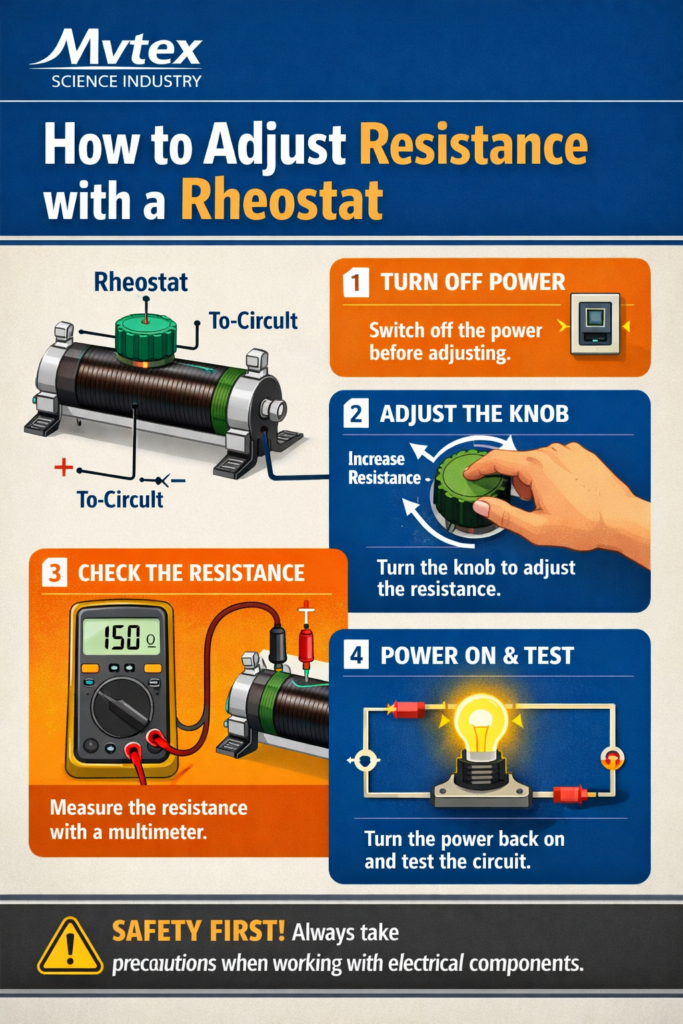
  • How to Adjust Resistance with a Rheostat

    Mastering Resistance Control: The Smart Way to Control Current

    Rheostat is a variable resistor. This is essential for Ohm’s Law experiments, as it enables users to change the resistance without breaking the circuit.

    You use a wiper to slide along a resistive wire to change the resistance, its a circuit. The means wiper moves and changes the length of wire in which current passes through, changing the resistance. This is what makes them ideal to use as the slider in the rheostats to control current in devices like a regulated power supply, which in fact is a very important part of even sensitive experiments.

    In a typical physics lab configuration, a meter bridge is used with a rheostat to find unknown resistors. The plug key diagram usually shows a rheostat to limit current when you insert the key and close the circuit. Students can see how voltage and current change by adjusting the resistance using the rheostat to reinforce Ohm’s Law applications.

    Another example of the use of rheostat is a lab water bath where very fine tuning of the temperature is required that there a rheostat is used for. A rheostat can be used to regulate the current across the heating element and produce a uniform heating effect. For example, on a hot plate for laboratory use, a rheostat allows for semi-continuous flow of the electric current, which keeps the temperature consistent all throughout the plate.

    To summarize, a rheostat is an easy to use and simple way to manipulate resistance in a variety of electrical scenarios. Whether we are using a meter bridge (an educational tool) or hot plate(lab water bath) in our lab, knowing how to change the resistance with a rheostat is essential for every lab personnel. Also a regulated power supply, and refer to your plug key diagram for the connections to your experiments.

    The process is a straightforward yet foundational one in a variety of physics and electronics experiments: Modify resistance with a rheostat. If you’re working in Ohm’s Law applications, having a well-controlled rheostat is critical whether you’re working with a regulated power supply, a meter bridge, or just wish to guarantee precise voltage/amperage. Everything from precise setups with a plug key diagram, to temperature maintenance with lab water baths, or hot plates for laboratory use — reliable equipment makes the difference. Mvtex: Your Optimal Choice in Quality and Performance for High End Lab Instruments like Rheostats So rely on Mvtex for accuracy in each laboratory test and unquestionable lastingness.