Vernier caliper synonym: A vernier caliper is a measuring instrument that is used to measure the dimensions with great precision. It can be further subdivided into smaller parts using a main scale and a vernier scale. Vernier caliper reading: It is an important instrument found in fields like engineering, manufacturing and scientific research.
A vernier caliper, for example, measures length using a main scale vernier scale. (The minimum length that can be signed for is its least count) its least count is 0.01 cm or 0.02 mm. A small thickness is measured by a spherometer. One of the burners used to heat substances in a chemistry lab. Lab glassware (also known as soda glassware) commonly consists of flasks and beakers. Fresh mercury is used in experiments, purified. They did not specify that this was a cork borer, a tool that cuts holes into corks.
A vernier caliper consists mainly of two scales:
Main Scale: A scale resembling a ruler, graduated in mm or inches.
Vernier Scale: This is a smaller, adjustable scale that moves along the main scale to give more accurate measurements.
The least count is the smallest measurement which a measuring instrument can read, so the accuracy of a vernier caliper depends on its least count. We find least count by the formula:
Let us suppose that the smallest division on the main scale is 1 mm and the vernier has 10 divisions.
How to Read a Vernier Caliper: Steps
1. Align the Object: Center the object in the jaws of the vernier caliper and close the caliper to hold the object snugly.
2. Read Main Scale: The main scale reading just before the zero of vernier scale represents the main scale reading.
3. Read the Vernier Scale: Look for the division where the vernier scale coincides exactly with a division on the main scale.
4. Apply the measurement: Add the reading of the main scale with the reading of the vernier scale ( this is calculated by the specific number of the division in line with the least count).
Example:
If the reading of main scale is 5.0 mm and 4th division of vernier scale coincides with any division of main scale then:
So the ultimate measurement is 5.4 mm.
Spherometer and Least Count
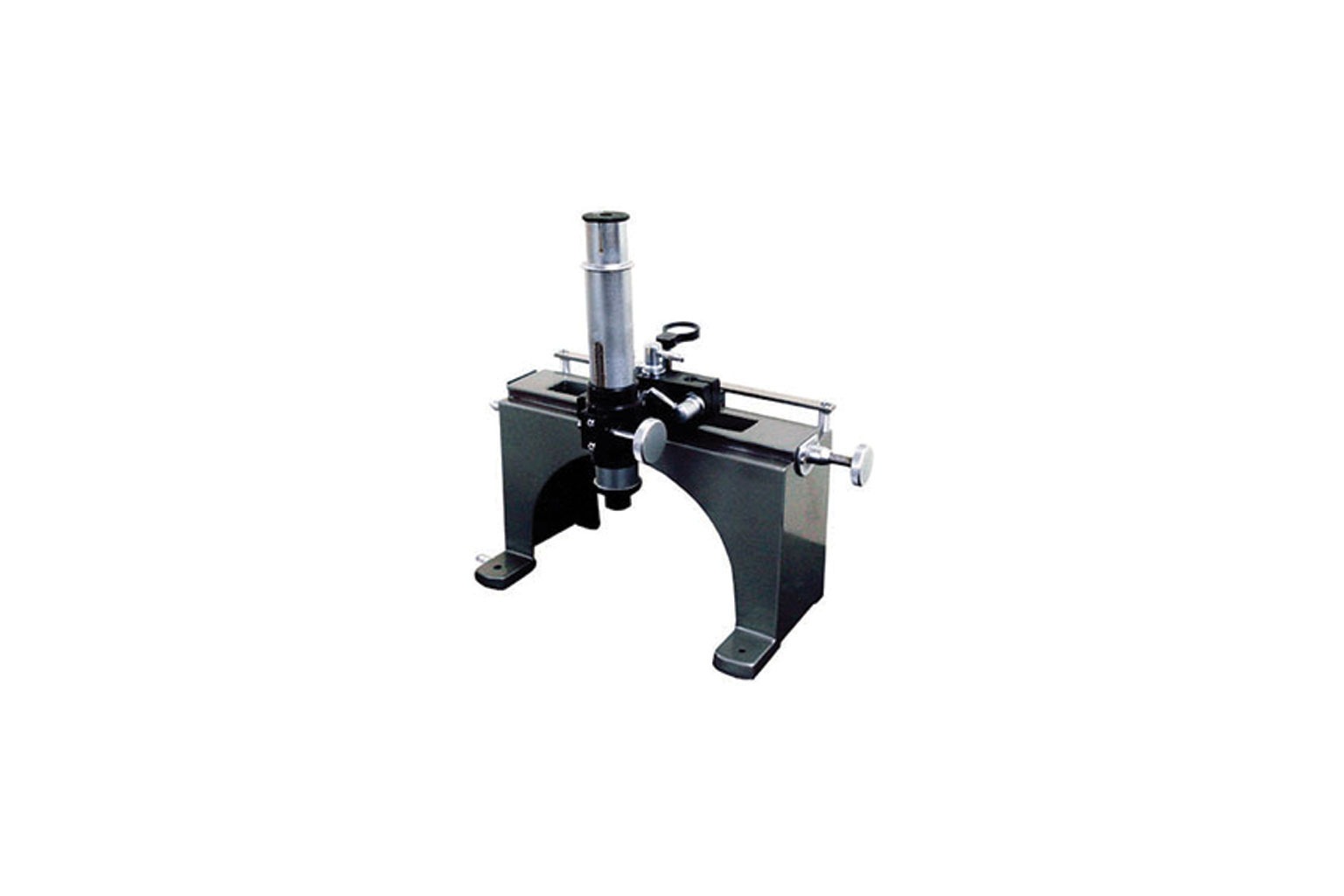
A spherometer is a device used to measure the curvature of spherical surfaces. Its design features a central screw and three outer legs, which create an equilateral triangle shape. A spherometer, just like a vernier caliper has a least count, given by:
Thus, for 100 divisions, the least count is given by the expression 100 mm = 0.01 mm.
Chemistry Lab Burner and Glasswares in Lab
The chemistry laboratory has a lot of equipment such as the chemistry lab burner and the laboratory glassware of the different kinds used to perform laboratory experiments.
Chemistry Lab Burner
For heating substances a chemistry lab burner (like a Bunsen burner) is used. The gas inlet, air regulator, and flame outlet. Air supply- Ideally, it should be adjusted to flame temperature and type.
Glassware in Lab
Some of the types of glassware used in laboratory are:
Beakers: For mixing and heating liquids
Flasks: Erlenmeyer and volumetric flasks for titrations and solution preparation.
Test Tubes: Glass tubes for experimental reactions.
Pipettes and Burettes — Accurate Measurement of Liquid
One year, one week, one day, and 21 hours.
Soda Glassware: Soda glassware is made from soda-lime glass, which is cheap, resists mild chemicals, but should not be used for high-temperature applications.
Uses of Mercury Purified Mercury purified: Mercury purified is used in a number of the scientific instruments like barometer or thermometer due to the reason of their high density and touch of liquid at normal temperature.
Cork Borer
It is common to use a cork borer for making holes in rubber or cork stoppers for inserting glass tubing or thermometers. It also comes in various size and very basic tool in laboratory setups.
Conclusion
Learning to utilize a vernier caliper, the spherometer, the chemistry lab burner and laboratory glassware are important for accurate measurements in science. Knowledge of these tools can help you do a better job in Laboratory science and Industrial Applications.
In scientific experiments, tools such as the spherometer least count are used to maintain accuracy. From measuring small components to laboratory tools, understanding these devices is essential for efficiency and accuracy.
In laboratory set up, it is always best to invest in high quality equipment. Every instrument from chemistry lab burner to glassware in lab is significant in research and experiments. Laboratory glassware most commonly composed of soda glass is popular for general application; it is used at moderate temperatures and is inexpensive, and its uses include standard laboratory glassware. For specialized needs, choose Mvtex Science Industry. Choose precision.